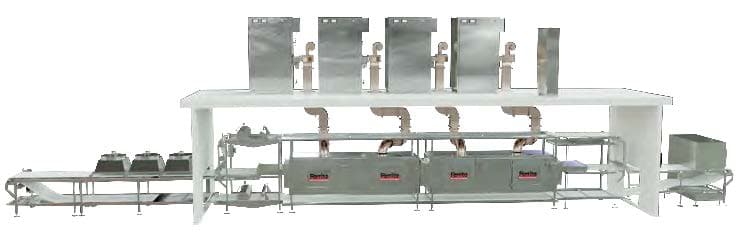
Bacon cooking is an industrial microwave food processing market that continues to grow, year after year. A large share of the industrial microwave cooking market is dedicated to pre-cooked bacon operations. We’ve witnessed the market growth first hand, and we’ve experienced our own progress through it. Our commitment to the various applications within the industrial microwave sector is visible through our array of systems. We’ve developed microwave cooking products to help transform the industry. With elevated power levels, automated system controls, and microwave accessories – Ferrite Microwave Technologies is dedicated to serving our industrial microwave clients.
A Brief History of Microwave Bacon Cooking
First introduced in the late 1970s, bacon cooking equipment entered the industrial microwave market as an unrefined process. Relative to today, slicing was done at slow speeds – at a modest 200 slices per minute. Likewise, microwave power systems operated in the 100kW range, a figure we would deem inadequate compared to today’s power levels. Once the bacon moved through the ovens, packaging was done by hand. The slow-moving and labor-intensive nature of production tasks often resulted in throughput back-ups.
Soon enough, the critical gaps in the industrial microwave equipment sector became exposed. The lack of speed via automation, coupled with high-cost labor and inefficient microwave power, pushed manufacturers toward new innovations. To their benefit, the automated systems translated into improved safety, a supplemental benefit with worker health and safety standards becoming more stringent.
As demand requirements grew, major food companies took an interest in the process. Microwave equipment manufacturers met the challenge by introducing more powerful systems in the 300kW range. Automation developed new high speed slicers (750 slices per minute) and conveyor systems for automatic packaging, and naturally, production capacities grew.
With new market entrants, the pre-cooked microwave bacon industry experienced a major boom in the late 1990’s into the 2000’s. As such, microwave precook installations jumped from 50 to 100 worldwide. High speed slicers nearly doubled their output, reaching 1,100 slices per minute. Within a few years, this figure doubled again. With the new millennium well underway, microwave power exceeded 800kW per system. Focuses shifted toward further optimization, with computer control systems and remote troubleshooting becoming possible with advances in computer technology.
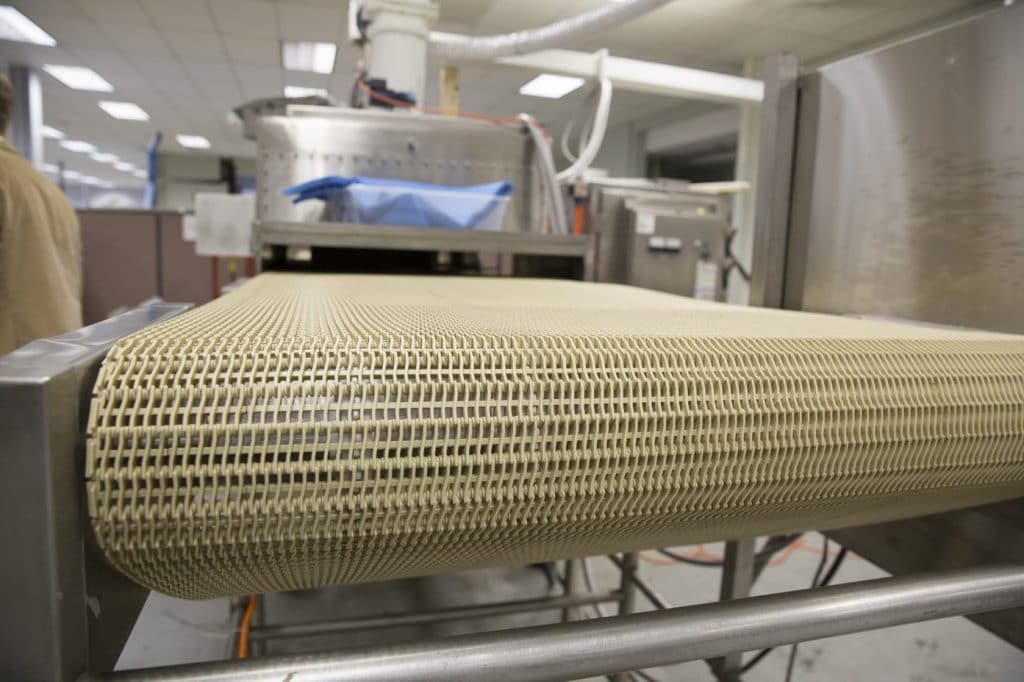
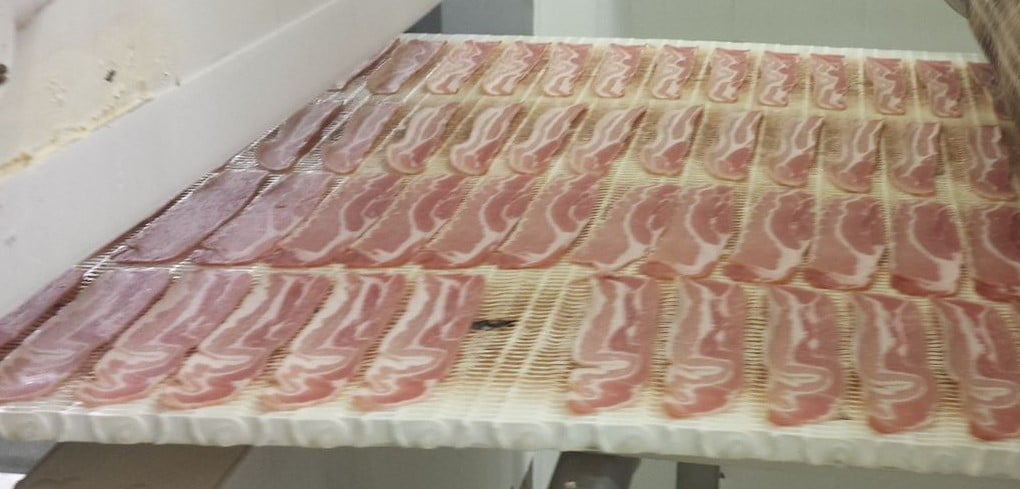
Today, microwave bacon sales and production continue to climb year-over-year. It is a multi-billion dollar industry that serves small-scale restaurants, local grocers, international franchises and households alike.
Benefits of Precooked Microwave Bacon Cooking
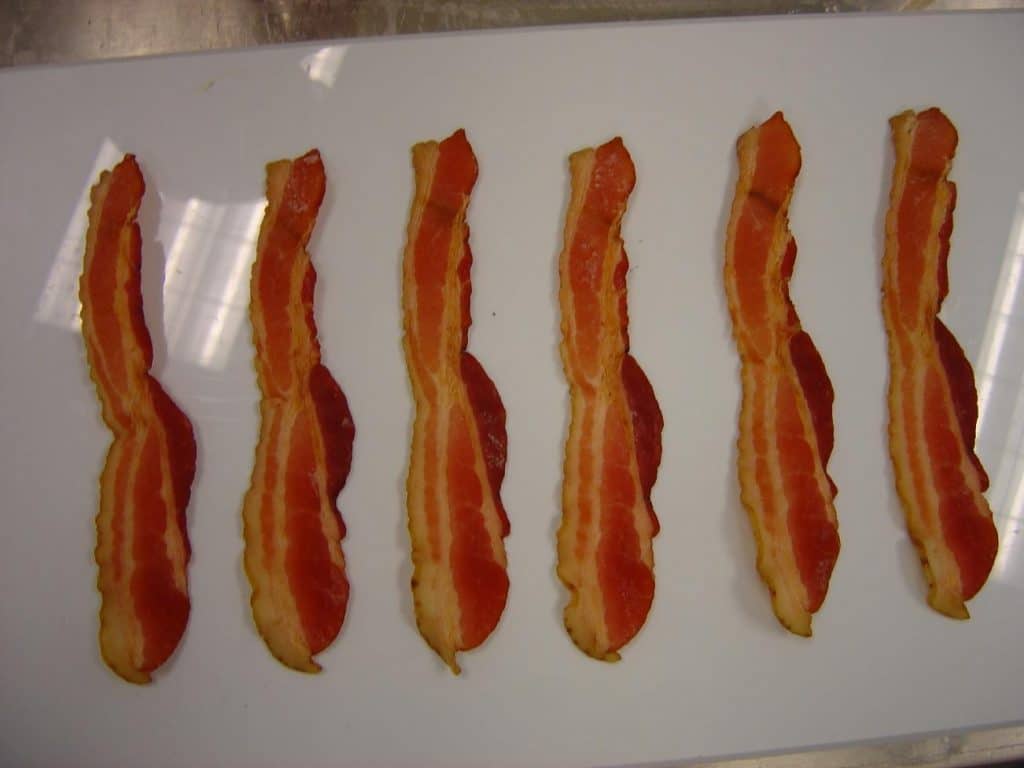
Precooked bacon cooking at an industrial level is highly lucrative. But before we jump into the obvious economic benefits, a quick overview on definitions and markets of precooked bacon may prove beneficial. By USDA definition, precooked bacon is “bacon which has been cooked to a finish yield of 40 percent or less.”
For precook markets, the first is the Hotel, Restaurant or Institution (HRI) sector. In this market, case counts of 300 slices are typical. The top players in this market are fast food restaurants. It is used on breakfast platters, sandwiches and hamburgers to add flavor. Cooked bits are sold in bulk as toppings for pizzas and salads.
The second market is retail. These are typically found in supermarkets, local grocers, convenience stores and even pharmacies. Much of the time, packages of 12 to 20 slice counts are found in dairy or deli sections of retail stores. In the case of retail, it is positioned and marketed as a convenience food to drive sales.
There are multiple reasons why industrial microwave technology is a manufacturer’s choice for precooking bacon. First off, it’s easy to do. Most of today’s systems are automated, user-friendly and fully compliant with safety standards. Bacon provides great conditions for rapid microwave cooking. When you choose microwave technology, you are not compromising the quality of the product. The texture of the bacon is closely controlled, resulting in an uncompromised taste. The uniformity of the cooking process applies the heat evenly, with no burning or curling of the edges.
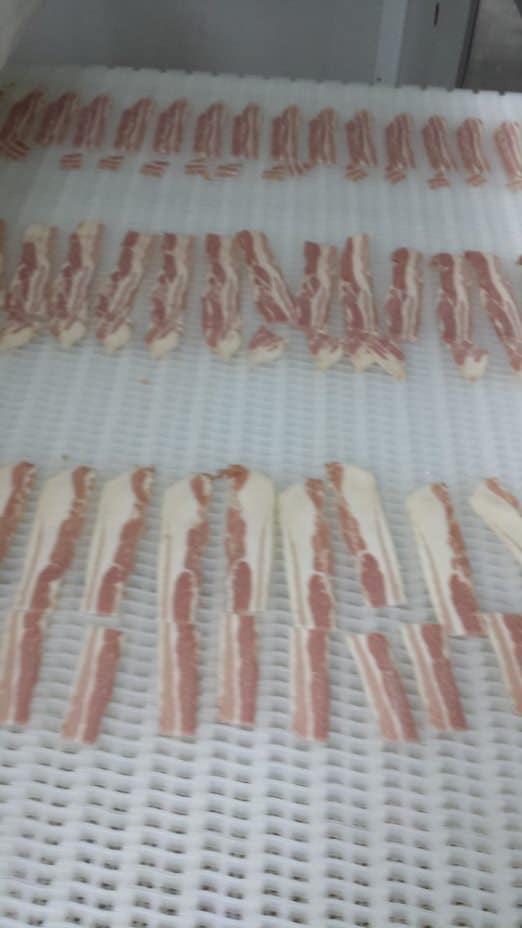
Another advantage to utilizing industrial systems for food processors is the ability to turn by-products into value, not waste. Bacon fat is easily collected and sold as a flavoring ingredient. Fats can be processed and turned into pet food, cosmetic products, and even used as supplemental power generation. By the same token, bacon bits, ends and pieces are used in other food products, as toppings or flavor additives. Likewise, rejected slices can be reduced in size, then sold as pieces and bits.
A final benefit to microwaving precooked bacon is profit. Given the extraordinary growth of the bacon processing market, we can assume alternatives to industrial microwaves have been considered. The process has shown to be more cost effective than other methods that have been considered, or are currently in use.
Microwave Processing Variables
There are many application factors at play when utilizing industrial microwave equipment. These include: product in question, desired temperature, running power levels, throughput, speed and many more. We’ve compiled a list of processing variables specific to bacon cooking applications, for your consideration:
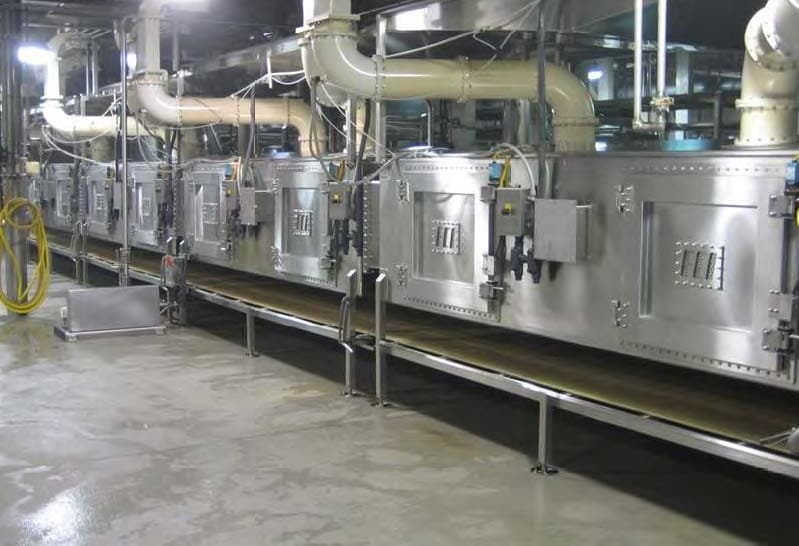
- Belly temperature
- Slice thickness
- Number of slices per minute
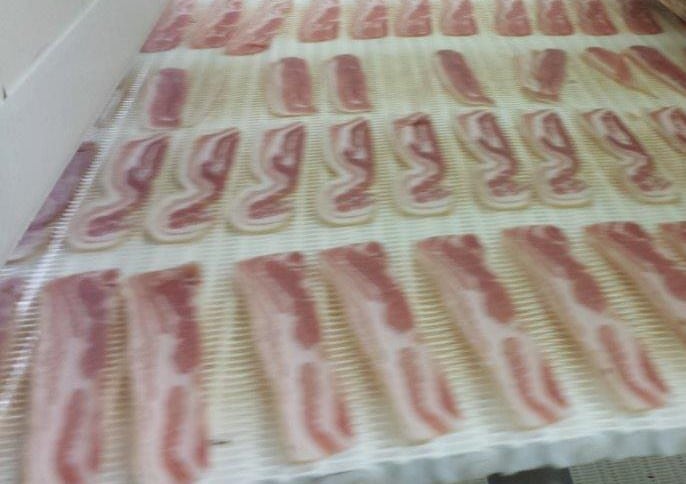
- Product density on belt
- Environment / Climate of facility
- Customer requirements
- Packaging requirements
- Belt speed
- Microwave power
- Ventilation
| Processing Variable | Factors to Consider |
|---|---|
| Belly temperature | • Established in cooler prior to slicing • Ensures proper slice and blade life • Too warm – poor slices • Too cold – dulls blade, causing slices to curl |
| Slice thickness | • Set on slicer • To meet customer requirements • Usually set at slices per inch of belly |
| Number of slices per minute | • To meet production rates and proper cook • Function of microwave power and effective cavity length |
| Product density on belt | • Function of belt speed, number of slices per minutes and slice thickness |
| Belt speed | • Important to manage to maintain proper slice spacing into the oven • Balance between number of slices per minute and microwave power |
| Microwave power | • Established to achieve target yield Color |
| Ventilation | • Proper ventilation effects energy efficiency • Effects uniformity of cook |
Bacon Quality Parameters
Smooth, efficient and continuous cooking are essential ingredients for meeting today’s production demands and quality standards. We pride ourselves on manufacturing quality and dependable industrial microwave equipment. Please consider the following quality parameters with regards to microwave bacon.
| Quality Parameter | Indicators + Factors to Consider |
|---|---|
| Cooked Yield Percentage | • Determined by weighing product prior and after cook |
| Slice thickness | • Thermometer used • Measured as fully cooked bacon exits the oven |
| Water activity | • Tested using standard lab equipment • Important for shelf stability |
| Product appearance | • Grease removed via air knives at exit end of oven • Targeted color uniformity |
We welcome you to our MIP 11 Microwave Oven Continuous Cooking System. It is the ideal solution for microwave bacon: